
Non-Disclosure Agreement (NDA) Template – Sample
Non-disclosure agreements are legal contracts that prohibit someone from sharing information deemed confidential. The confidential information is defined in the agreement which includes, but not limited to, proprietary information, trade secrets, and any other details which may include personal information or events.
Adobe PDF, Microsoft Word (.docx)

Table of Contents
Types of NDA’s
Basic / Standard NDA – Use when disclosing secrets to a contractor, a potential investor, or a prospective business partner.
Business Plan NDA – When showing a business plan to a third (3rd) party such as a potential investor.
Business Sale NDA – Use when you’re engaged in business negotiations. For example, merger or investment discussions, negotiations about joint ventures or talks with consultants or potential licensees.
Cease and Desist Letter (NDA Violation) – To send to an individual that has violated an NDA that was previously authorized.
Commercial Real Estate NDA (Confidentiality) – When a landlord is seeking to sell or lease their property this agreement would be signed by all potential buyers or tenants.
Customer List NDA – For companies that sell their customer lists to other entities.
Employee NDA – Makes clear to an employee that he or she may not disclose your trade secrets without permission
Film (Movie) NDA – To share a script with producers, directors, and actors.
Financial Information NDA – To disclose personal or business financial information to a third (3rd) party.
HIPAA Employee NDA – For employees of healthcare facilities to agree that they will not share medical information of the patients.
Independent Contractor NDA – Also referred to as a 1099 employee, is for contractors that will have access to sensitive information.
Intern (Internship) NDA – For an intern that is serving a temporary position.
Job Interview NDA – You may end up divulging trade secrets when interviewing prospective employees, especially for sensitive jobs. Any person you hire should be required to sign an employee NDA (or an employment agreement containing a nondisclosure provision). But, of course, the interviewees you don’t hire won’t be signing an employment NDA or employment agreement. For this reason, have applicants for sensitive positions sign a simple nondisclosure agreement at the beginning of a job interview.
Landlord-Tenant NDA – In order for the landlord to safely handover information about the property to the tenant.
Mutual NDA – Also known as a “2-way NDA”, allows for two (2) parties to share trade secrets while both being bound to keep the information private.
Patent (Invention) NDA – Specifically written to protect a patent or invention from employees, contractors, or any other third (3rd) party from sharing or copying the concept.
Product Development NDA – To protect a product in its early stages before being able to file for a patent.
Real Estate Buyer NDA – For a landlord that will be disclosing pertinent financial information to a potential buyer.
Software Beta Tester NDA – If you develop software (including Web applications) and give beta versions to outside testers, here is a nondisclosure agreement for you to use.
Software Development NDA – To protect oneself from coders and programmers so that they do not steal an idea or reuse the coding or design.
Student NDA – For a student of a college or university that is to be working within its internal administration and affairs.
Trade Secret (Specific) NDA – If a specific trade secret or piece of information is to be kept confidential.
Unilateral NDA – For any type of NDA where only one (1) party will be responsible for keeping the information a secret.
Visitor NDA – For any guest that is visiting a business. They will not be able to share the things they see on their tour.
Volunteer NDA – For any guest or individual that is agreeing to work without pay.
Website Design NDA – To have a designer promise not to share the logos or design practices that they use on your website.
NDA Sample
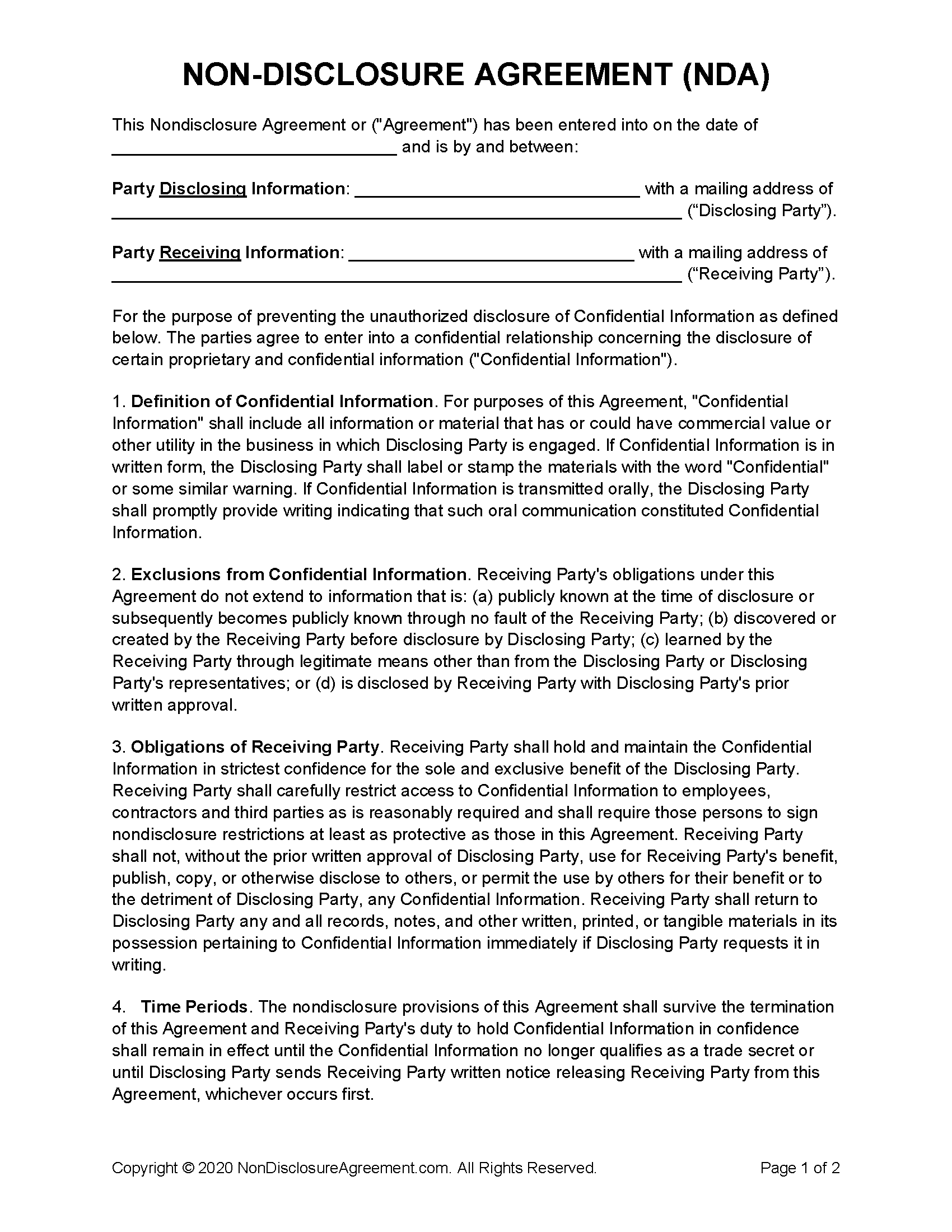
This Nondisclosure Agreement (the “Agreement”) is entered into by and between _______________ with its principal offices at _______________, (“Disclosing Party“) and _______________, located at _______________ (“Receiving Party“) for the purpose of preventing the unauthorized disclosure of Confidential Information as defined below. The parties agree to enter into a confidential relationship with respect to the disclosure of certain proprietary and confidential information (“Confidential Information”).
1. Definition of Confidential Information. For purposes of this Agreement, “Confidential Information” shall include all information or material that has or could have commercial value or other utility in the business in which Disclosing Party is engaged. If Confidential Information is in written form, the Disclosing Party shall label or stamp the materials with the word “Confidential” or some similar warning. If Confidential Information is transmitted orally, the Disclosing Party shall promptly provide a writing indicating that such oral communication constituted Confidential Information.
2. Exclusions from Confidential Information. Receiving Party’s obligations under this Agreement do not extend to information that is: (a) publicly known at the time of disclosure or subsequently becomes publicly known through no fault of the Receiving Party; (b) discovered or created by the Receiving Party before disclosure by Disclosing Party; (c) learned by the Receiving Party through legitimate means other than from the Disclosing Party or Disclosing Party’s representatives; or (d) is disclosed by Receiving Party with Disclosing Party’s prior written approval.
3. Obligations of Receiving Party. Receiving Party shall hold and maintain the Confidential Information in strictest confidence for the sole and exclusive benefit of the Disclosing Party. Receiving Party shall carefully restrict access to Confidential Information to employees, contractors and third parties as is reasonably required and shall require those persons to sign nondisclosure restrictions at least as protective as those in this Agreement. Receiving Party shall not, without the prior written approval of Disclosing Party, use for Receiving Party’s own benefit, publish, copy, or otherwise disclose to others, or permit the use by others for their benefit or to the detriment of Disclosing Party, any Confidential Information. Receiving Party shall return to Disclosing Party any and all records, notes, and other written, printed, or tangible materials in its possession pertaining to Confidential Information immediately if Disclosing Party requests it in writing.
4. Time Periods. The nondisclosure provisions of this Agreement shall survive the termination of this Agreement and Receiving Party’s duty to hold Confidential Information in confidence shall remain in effect until the Confidential Information no longer qualifies as a trade secret or until Disclosing Party sends Receiving Party written notice releasing Receiving Party from this Agreement, whichever occurs first.
5. Relationships. Nothing contained in this Agreement shall be deemed to constitute either party a partner, joint venturer or employee of the other party for any purpose.
6. Severability. If a court finds any provision of this Agreement invalid or unenforceable, the remainder of this Agreement shall be interpreted so as to best to effect the intent of the parties.
7. Integration. This Agreement expresses the complete understanding of the parties with respect to the subject matter and supersedes all prior proposals, agreements, representations, and understandings. This Agreement may not be amended except in a writing signed by both parties.
8. Waiver. The failure to exercise any right provided in this Agreement shall not be a waiver of prior or subsequent rights.
9. Notice of Immunity [OPTIONAL]. Employee is provided notice that an individual shall not be held criminally or civilly liable under any federal or state trade secret law for the disclosure of a trade secret that is made (i) in confidence to a federal, state, or local government official, either directly or indirectly, or to an attorney; and (ii) solely for the purpose of reporting or investigating a suspected violation of law; or is made in a complaint or other document filed in a lawsuit or other proceeding, if such filing is made under seal. An individual who files a lawsuit for retaliation by an employer for reporting a suspected violation of law may disclose the trade secret to the attorney of the individual and use the trade secret information in the court proceeding, if the individual (i) files any document containing the trade secret under seal; and (ii) does not disclose the trade secret, except pursuant to court order.
This Agreement and each party’s obligations shall be binding on the representatives, assigns and successors of such party. Each party has signed this Agreement through its authorized representative.
DISCLOSING PARTY
Signature _____________________________________________________
Typed or Printed Name ___________________________ Date: _______________
RECEIVING PARTY
Signature _____________________________________________________
Typed or Printed Name ___________________________ Date: _______________
Trade Secrets
An NDA can help safeguard business assets, including but not limited to, the following:
- Processes
Chemical, mechanical and manufacturing processes are commonly protected under nondisclosure agreements. Examples include processes for manufacturing chocolate powder, chicken pox vaccine or marble picture frames.
- Business Strategies and Methods
Business strategies such as marketing schemes, advertising campaigns, business plans and new product announcements can be protected as trade secrets. For example, courts have held that marketing strategies for the sale of propane gas and a business plan for a new franchise are trade secrets. A business method, a manner of conducting business or a way of doing business, is also a protectable trade secret. Examples include a system for analyzing mortgage rates or a process for instructing employees.
- Designs Blueprints and Specifications
Designs for products, machines, and structures, or other manufacturing specifications, can be protected as trade secrets. Examples include the design for a photo-processing machine, the blueprint for a casino or specifications for a paint roller.
- Formulas
Formulas are an obvious choice for trade secret protection—the most well-known is the secret combination of flavoring oils and other ingredients that give Coca-Cola its distinctive taste (referred to by the company as “Merchandise 7X”). Other formulas that could be protected as trade secrets include pharmaceutical, chemical and cosmetic compounds.
- Physical Devices and Articles
Physical devices such as machines, devices or objects can be subject to trade secret protection. Usually, trade secret protection is lost once the device is made public, but protection may enable you to protect it before obtaining a patent or while attempting to sell or license the product.
- Computer Software
Computer software is commonly protected under trade secret law because the underlying software code is not readily ascertainable or generally known. A computer program often qualifies for trade secret status during its development and testing stage. (It may also qualify for protection under copyright or patent law.)
- Customer Lists
Companies are often very eager to protect their customer lists with NDAs, particularly when a former employee might use a customer list to contact clients. If a dispute over a customer list ends up in court, a judge generally considers the following elements to decide whether or not a customer list qualifies as a trade secret:
- Is the information in the list ascertainable by other means? A list that is readily ascertainable cannot be protected.
- Does the list include more than names and addresses? For example, a customer list that includes pricing and special needs is more likely to be protected because this information adds value.
- Did it take a lot of effort to assemble the list? A customer list that requires more effort is more likely to be protected under an NDA.
- Did the departing employee contribute to the list? If the departing employee helped create it or had personal contact with the customers, it is less likely to be protected under an NDA.
- Is the customer list personal, long-standing or exclusive? If a business can prove that a customer list is special to its business and has been used for a long time, the list is more likely to be protected.
Customer List – Example 1: A salesman worked for an insurance company selling credit life insurance to automobile dealers. When he switched jobs to work for a competing insurance company he took his customer list and contacted the customers at his new job. A court ruled that the customer list was not a trade secret because the names of the automobile dealers were easily ascertainable by other means and because the salesman had contributed to the creation of the list. Lincoln Towers Ins. Agency v. Farrell, 99 Ill. App. 3d 353, 425 N.E.2d 1034 (1981).
Customer List – Example 2: Former employees took the client list of a temporary employment service. The former employees argued that the list could not be a trade secret since the information could be obtained through other means. A court disagreed and prevented the ex-employees from using the list because it could not be shown, using public information, which companies were likely to use temporary employees and because the list also included such information as the volume of the customer’s business, specific customer requirements, key managerial customer contacts and billing rates. Courtesy Temporary Serv. Inc. v. Camacho, 222 Cal. App. 3d 1278 (1990).
Wholesalers’ lists of retail concerns are often hard to protect as trade secrets. Retailers are usually easy to identify through trade directories and other sources, and a list of them ordinarily does not confer a competitive advantage. But there are exceptions—for instance, a list of bookstores that order certain types of technical books and pay their bills promptly may be very valuable to a wholesale book distributor. But if the information is readily ascertainable through trade publications or other industry sources, it is not classified as a trade secret.
In a California case, a court determined that employees who left a business could use their former employer’s mailing list to send out an announcement of their change of employment to former clients. The former employer’s mailing list was not a trade secret because: (1) the clients became known to the ex-employees through personal contacts; and (2) the use of the customer list simply saved the ex-employees the minor inconvenience of looking up the client addresses and phone numbers. In other words, the information was easy to ascertain. Moss, Adams & Co. v. Shilling, 179 Cal. App. 3d 124 (1984).
- Collections of Data
A database—information of any type organized in a manner to facilitate its retrieval—is often protected as a trade secret. For example, a court ruled that a database for inventorying and cost economies on wholesale sandwich production for fast-food retailers was a protectable trade secret. One Stop Deli, Inc. v. Franco’s, Inc., 1994-1 CCH Trade Cas. P 70,507 (W.D. Va. 1993). A collection of data that is readily ascertainable, however, is not a trade secret.
Databases may also be protected under copyright law if the method of compiling or arranging the data is sufficiently creative.
- Know-How
Know-how does not always refer to secret information. Sometimes it means a particular kind of technical knowledge that may not be confidential but that is needed to accomplish a task. For example, an employee’s know-how may be necessary to train other employees in how to make or use an invention. Although know-how is a combination of secret and nonsecret information, we suggest that you treat it as a protectable trade secret. If you disclose know-how to employees or contractors, use a nondisclosure agreement.
Glossary
Cease and Desist – A letter from the owner of a trade secret (or copyright, patent or trademark) that requests that alleged illegal activity is stopped immediately.
Clean Room – A method of developing proprietary material in which an isolated development team is monitored. The purpose is to provide evidence that similarities to others’ works or products are due to legitimate constraints and not copying.
Common Law – A system of legal rules derived from the precedents and principles established by court decisions.
Copyright – The legal right to exclude others, for a limited time, from copying, selling, performing, displaying or making derivative versions of a work of authorship such as a writing, music or artwork.
Database – Information of any type organized in a manner to facilitate its retrieval.
Declaratory Relief – An order from a court sorting out the rights and legal obligations of the parties in the midst of an actual controversy.
Diversity Jurisdiction – Federal courts’ right to hear lawsuits based upon non-federal claims; parties must be from different states and the amount in controversy over $50,000.
Economic Espionage Act – A law making it a federal crime to steal a trade secret or to receive or possess trade secret information knowing that it is stolen.
Evaluation Agreement – A contract in which one party promises to submit an idea and the other party promises to evaluate it. After the evaluation, the evaluator will either enter into an agreement to exploit the idea or promise not to use or disclose the idea.
Fiduciary Relationship – When one person stands in a special relationship of trust, confidence or responsibility to another.
Generally Known – Information is generally known if it has been published or publicly displayed or is commonly used within an industry.
Improper Means – The illegal acquisition of trade secrets through theft, bribery, misrepresentation, breach or inducement of a breach of a duty to maintain secrecy or espionage through electronic or other means.
Inevitable Disclosure Doctrine – Under this court-made rule, adopted by only a few courts, a court can stop an ex-employee from working for a competitor if the former employer shows that the employee will “inevitably disclose” trade secrets of the former employer.
Injunction – A court order requiring that a party halt a particular activity. A court can issue an injunction at the end of a trial (a permanent injunction) or immediately, rather than wait for a trial (a preliminary injunction).
Two factors are used when a court determines whether to grant a preliminary injunction:
(1) Is the plaintiff (the party bringing the lawsuit) likely to succeed in the lawsuit? and
(2) Will the plaintiff suffer irreparable harm if the injunction is not granted?
The plaintiff may seek a temporary restraining order, which lasts only a few days or weeks. A temporary restraining order may be granted without notice to the infringer if it appears that immediate damage will result-for example, that evidence will be destroyed.
Jurisdiction – The authority of a court to hear a certain type of case.
Know-How – A particular kind of technical knowledge that may not be confidential but that is needed to accomplish a task.
License – A contract giving written permission to use an invention, creative work, trade secret or trademark, in return for payment.
Misappropriation – The theft or illegal disclosure of trade secrets.
Non-Competition Agreement – A contract in which a person or company agrees not to compete with the business of another company for a period of time.
Non-Solicitation Provision (also known as a “diversion provision) An agreement that restricts an ex-employee’s ability to solicit clients or employees of the ex-employer.
Option Agreement – An agreement in which one party pays the other for the opportunity to later exploit an innovation, idea or product.
Patent – A grant from a government that confers upon an inventor the right to exclude others from making, using, selling, importing, or offering an invention for sale for a fixed period of time.
Readily Ascertainable – Information readily ascertainable if it can be obtained legally within an industry, at a library or through publicly available reference sources.
Reverse Engineering – Disassembly and examination of products that are available to the public.
Trademark – Any word, symbol, design, device, slogan or combination that identifies and distinguishes goods.
Trade Secret – Any formula, pattern, device or compilation of information that is used in business, that is not generally known, and that gives the owner of the secret an opportunity to obtain an advantage over competitors who do not know or use it.
Uniform Trade Secrets Act (UTSA) – An act created by lawyers, judges, and scholars, and adopted by 43 states and the District of Columbia, in order to confirm the trade secret rules of different states
Work Made for Hire – (1) A copyrightable work prepared by an employee within the scope of employment; or (2) A copyrightable work specially ordered or
commissioned for use as a contribution to a collective work, as a part of a motion picture or other audiovisual work, as a translation, as a supplementary work, as a compilation, as an instructional text, as a test, as answer material for a test, or as an atlas, if the parties expressly agree in a written instrument signed by them that the work shall be considered a work made for hire.
How to Write an NDA
Download the Basic Non-Disclosure Agreement in Adobe PDF or Microsoft Word (.docx).
Introduction Paragraph
In the Sample NDA Agreement, the “Disclosing Party” is the person disclosing secrets, and the “Receiving Party” is the person or company who receives the confidential information and is obligated to keep it secret. The terms are capitalized to indicate they are defined in the agreement. The sample agreement is a “one-way” (or in legalese, “unilateral”) agreement-that is, only one party is disclosing secrets.
Mutual Agreements Clause [OPTIONAL]
If both sides are disclosing secrets to each other you should modify the agreement to make it a mutual (or “bilateral”) nondisclosure agreement. To do that, substitute the following paragraph for the first paragraph of the agreement.
This Nondisclosure agreement (the “Agreement”) is entered into by and between ____ [insert your name, business form and address] and ____ [insert name, business form and address of other person or company with whom you are exchanging information] collectively referred to as the “parties” for the purpose of preventing the unauthorized disclosure of Confidential Information as defined below. The parties agree to enter into a confidential relationship with respect to the disclosure by one or each (the “Disclosing Party”) to the other (the “Receiving Party”) of certain proprietary and confidential information (the “Confidential Information”).
1. Definition of Confidential Information
Every nondisclosure agreement defines its trade secrets, often referred to as “confidential information.” This definition establishes the subject matter of the disclosure. There are three common approaches to defining confidential information: (1) using a system to mark all confidential information; (2) listing trade secret categories; or (3) specifically identifying the confidential information.
What’s best for your company? That depends on your secrets and how you disclose them. If your company is built around one or two secrets-for example, a famous recipe or formula-you can specifically identify the materials. You can also use that approach if you are disclosing one or two secrets to a contractor. If your company focuses on several categories of secret information, for example, computer code, sales information and marketing plans, a list approach will work with employees and contractors. If your company has a wide variety of secrets and is constantly developing new ones, you should specifically identify secrets.
If confidential information is fairly specific, for example, a unique method of preparing income tax statements-define it specifically.
Example – Specific Confidential Clause
Another approach to identifying trade secrets is to state that the disclosing party will certify what is and what is not confidential. For example, physical disclosures such as written materials or software will be clearly marked “Confidential.” In the case of oral disclosures, the disclosing party provides written confirmation that a trade secret was disclosed. Here is an appropriate provision that was taken from the sample NDA in the previous section.
Example Broad Confidential Clause
When confirming an oral disclosure, avoid disclosing the content of the trade secret. An email or letter is acceptable, but the parties should keep copies of all such correspondence. A sample letter is shown below.
Letter Confirming Oral Disclosure
Dear Sam,
Today at lunch, I disclosed information to you about my kaleidoscopic projection system, specifically, the manner in which I have configured and wired the bulbs to the device. That information is confidential (as described in our nondisclosure agreement) and this letter is intended to confirm the disclosure.
2. Exclusions from Confidential Information
You cannot prohibit the receiving party from disclosing information that is publicly known, legitimately acquired from another source or developed by the receiving party before meeting you. Similarly, it is not unlawful if the receiving party discloses your secret with your permission. These legal exceptions exist with or without an agreement, but they are commonly included in a contract to make it clear to everyone that such information is not considered a trade secret.
In some cases, a business presented with your nondisclosure agreement may request the right to exclude information that is independently developed after the disclosure. In other words, the business might want to change subsection (b) to read, “(b) discovered or independently created by Receiving Party prior to or after disclosure by Disclosing Party.”
By making this change, the other company can create new products after exposure to your secret, provided that your secret is not used to develop them. You may wonder how it is possible for a company once exposed to your secret to developing a new product without using that trade secret. One possibility is that one division of a large company could invent something without any contact with the division that has been exposed to your secret. Some companies even establish clean room methods.
Although it is possible for a company to independently develop products or information without using your disclosed secret, we recommend avoiding this modification if possible.
3. Obligations of Receiving Party
The heart of a nondisclosure agreement is a statement establishing a confidential relationship between the parties. The statement sets out the duty of the Receiving Party to maintain the information in confidence and to limit its use. Often, this duty is established by one sentence: “The Receiving Party shall hold and maintain the Confidential Information of the other party in strictest confidence for the sole and exclusive benefit of the Disclosing Party.” In other cases, the provision may be more detailed and may include obligations to return information. A detailed provision is provided below.
The simpler provision is usually suitable when entering into an NDA with an individual such as an independent contractor. Use the more detailed one if your secrets may be used by more than one individual within a business. The detailed provision provides that the receiving party has to restrict access to persons within the company who are also bound by this agreement.
In some cases, you may want to impose additional requirements. For example, the Beta Tester Nondisclosure Agreement contains a prohibition against reverse engineering, decompiling or disassembling the software. This prohibits the receiving party (the user of licensed software) from learning more about the trade secrets.
You may also insist on the return of all trade secret materials that you furnished under the agreement. In that case, add the following language to the receiving party’s obligations.
4. Duration of Agreement
How long does the duty of confidentiality last? The sample agreement offers three alternative approaches: an indefinite period that terminates when the information is no longer a trade secret; a fixed period of time; or a combination of the two.
Example – Unlimited (Perpetual) Time Period Clause
Example – Fixed Time-Period Clause
Example – Fixed Time Period With Exceptions Clause
This Agreement and Receiving Party’s duty to hold Disclosing Party’s Confidential Information in confidence shall remain in effect until __________ or until one of the following occurs:
- (a) the Disclosing Party sends the Receiving Party written notice releasing it from this Agreement, or
- (b) the information disclosed under this Agreement ceases to be a trade secret.
The time period is often an issue of negotiation. You, as the disclosing party, will usually want an open period with no limits; receiving parties want a short period. For employee and contractor agreements, the term is often unlimited or ends only when the trade secret becomes public knowledge. Five years is a common length in nondisclosure agreements that involve business negotiations and product submissions although many companies insist on two or three years.
We recommend that you seek as long a time as possible, preferably unlimited. But realize that some businesses want a fixed period of time and some courts, when interpreting NDAs, require that the time period be reasonable. Determining “reasonableness” is subjective and depends on the confidential material and the nature of the industry. For example, some trade secrets within the software or Internet industries may be short-lived. Other trade secrets. For example, the Coca-Cola formula-have been preserved as a secret for over a century. If it is likely, for example, that others will stumble upon the same secret or innovation or that it will be reverse engineered within a few years, then you are unlikely to be damaged by a two- or three-year period. Keep in mind that once the time period is over, the disclosing party is free to reveal your secrets.
5. Relationships
Your relationship with the receiving party is usually defined by the agreement that you are signing. For example, an employment, licensing or investment agreement. To an outsider, it may appear that you have a different relationship, such as a partnership or joint venture. It’s possible that an unscrupulous business will try to capitalize on this appearance and make a third-party deal. That is, the receiving party may claim to be your partner to obtain a benefit from a distributor or sublicensee. To avoid liability for such a situation, most agreements include a provision like this one, disclaiming any relationship other than that defined in the agreement. We recommend that you include such a provision and take care to tailor it to the agreement. For example, if you are using it in an employment agreement, you would delete the reference to employees. If you are using it in a partnership agreement, take out the reference to partners, and so forth.
6. Severability
The severability clause provides that if you wind up in a lawsuit over the agreement and a court rules that one part of the agreement is invalid, that part can be cut out and the rest of the agreement will remain valid. If you don’t include a severability clause and some portion of your agreement is deemed invalid, then the whole agreement may be canceled.
7. Integration
In the process of negotiation and contract drafting, you and the other party may make any oral or written statements. Some of these statements make it into the final agreement. Others don’t. The integration provision verifies that the version you are signing is the final version and that neither of you can rely on statements made in the past. This is it! Without an integration provision, it’s possible that either party could claim rights based upon promises made before the deal was signed.
A second function of the integration provision is to establish that if any party makes promises after the agreement is signed, those promises will be binding only if they are made in a signed amendment (addendum) to the agreement.
The integration clause closes the door on any oral or written promises. Don’t sign an agreement if something is missing and don’t accept an assurance that the other party will correct it later.
8. Waiver
This provision states that even if you don’t promptly complain about a violation of the NDA, you still have the right to complain about it later. Without this kind of clause, if you know the other party has breached the agreement but you let it pass, you give up (waive) your right to sue for it.
For example, imagine that the receiving party is supposed to use the secret information in two products but not in a third. You’re aware that the receiving party is violating the agreement, but you are willing to permit it because you are being paid more money and don’t have a competing product. After several years, however, you no longer want to permit the use of the secret in the third product. A waiver provision makes it possible for you to sue. The receiving party cannot defend itself by claiming it relied on your past practice of accepting its breaches. Of course, the provision swings both ways. If you breach the agreement, you cannot rely on the other party’s past acceptance of your behavior.