Employee Non-Disclosure Agreement (NDA)

 Fill Now
The sole purpose of the employee non-disclosure agreement is to make clear to an employee that he or she may not disclose your trade secrets without permission. Lawyers recommend that employers use such agreements prior to an employee starting work. If the agreement is with a current employee, we recommend that you give the employee something of value over and above normal salary and benefits.
Employee NDA Template – Adobe PDF, Microsoft Word (.docx)
Independent Contractor NDA – Otherwise known as a “1099 contractor” referring to the tax status of the individual. Much like the employee NDA, allows a company to protect its proprietary information while hiring the services of an independent contractor.
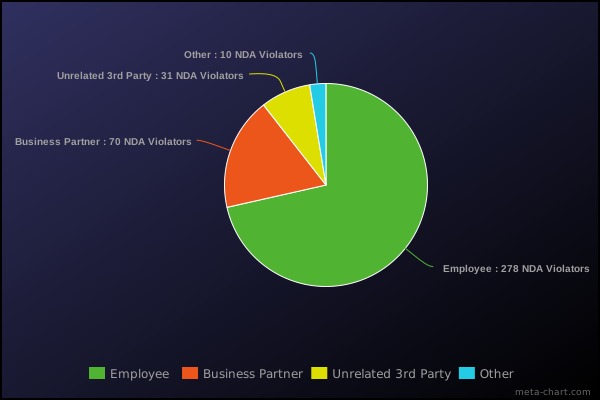
Table of Contents
- Employee NDA Template
- Employee NDA Sample
- Employee NDA How to Write
- Defend Trade Secrets Act (DTSA)
- Protecting Your Trade Secrets
- Violating Trade Secrets
Employers’ Notice
Under the Defend Trade Secrets Act, employers are now required to include a Notice of Immunity provision in any contract or agreement with an employee that governs the use of a trade secret or other confidential information.
The notice should also be included in agreements for independent contractors as well. An employer who fails to include the provision is prohibited from recovering exemplary (double) damages and attorney fees from the employee or IC. The failure to include the provision does not prevent filing in federal court under the DTSA.
Employee NDA Sample
EMPLOYEE NONDISCLOSURE AGREEMENT
This agreement (the “Agreement”) is entered into by ________________ (“Company”) and ________________ (“Employee”).
[Alternative 1]
In consideration of the commencement of Employee’s employment with Company and the compensation that will be paid, Employee and Company agree as follows:
[Alternative 2]
In consideration of Employee’s continued employment with Company and also in consideration of:
[Choose one]
☐ – the amount of $____________________
☐ – options to purchase shares of Company’s stock
☐ – ________________
the receipt and sufficiency of which is acknowledged, the parties agree as follows:
In the performance of Employee’s job duties with Company, Employee will be exposed to Company’s Confidential Information. “Confidential Information” means information or material that is commercially valuable to Company and not generally known or readily ascertainable in the industry. This includes, but is not limited to:
(a) technical information concerning Company’s products and services, including product know-how, formulas, designs, devices, diagrams, software code, test results, processes, inventions, research projects and product development, technical memoranda and correspondence;
(b) information concerning Company’s business, including cost information, profits, sales information, accounting and unpublished financial information, business plans, markets and marketing methods, customer lists and customer information, purchasing techniques, supplier lists and supplier information and advertising strategies;
(c) information concerning Company’s employees, including salaries, strengths, weaknesses, and skills;
(d) information submitted by Company’s customers, suppliers, employees, consultants or co-venture partners with Company for study, evaluation or use; and
(e) any other information not generally known to the public which, if misused or disclosed, could reasonably be expected to adversely affect Company’s business.
2. Nondisclosure of Trade Secrets
The Employee shall keep Company’s Confidential Information, whether or not prepared or developed by Employee, in the strictest confidence. The Employee will not disclose such information to anyone outside Company without Company’s prior written consent. Nor will Employee make use of any Confidential Information for Employee’s own purposes or the benefit of anyone other than Company.
However, Employee shall have no obligation to treat as confidential any information which:
(a) was in Employee’s possession or known to Employee, without an obligation to keep it confidential, before such information was disclosed to Employee by Company;
(b) is or becomes public knowledge through a source other than Employee and through no fault of Employee, or
(c) is or becomes lawfully available to Employee from a source other than Company.
3. Confidential Information of Others
The Employee will not disclose to Company, use in Company’s business, or cause Company to use, any trade secret of others.
When Employee’s employment with Company ends, for whatever reason, Employee will promptly deliver to Company all originals and copies of all documents, records, software programs, media and other materials containing any Confidential Information. The Employee will also return to Company all equipment, files, software programs and other personal property belonging to Company.
5. Confidentiality Obligation Survives Employment
Employee’s obligation to maintain the confidentiality and security of Confidential Information remains even after Employee’s employment with Company ends and continues for so long as such Confidential Information remains a trade secret.
6. General Provisions
(a) Relationships: Nothing contained in this Agreement shall be deemed to make Employee a partner or joint venturer of Company for any purpose.
(b) Severability: If a court finds any provision of this Agreement invalid or unenforceable, the remainder of this Agreement shall be interpreted so as to best to effect the intent of Company and Employee.
(c) Integration: This Agreement expresses the complete understanding of the parties with respect to the subject matter and supersedes all prior proposals, agreements, representations, and understandings. This Agreement may not be amended except in a writing signed by both Company and Employee.
(d) Waiver: The failure to exercise any right provided in this Agreement shall not be a waiver of prior or subsequent rights.
(e) Injunctive Relief: Any misappropriation of any of the Confidential Information in violation of this Agreement may cause Company irreparable harm, the amount of which may be difficult to ascertain, and therefore the Employee agrees that Company shall have the right to apply to a court of competent jurisdiction for an order enjoining any such further misappropriation and for such other relief as Company deems appropriate. This right is to be in addition to the remedies otherwise available to Company.
(f) Indemnity: The Employee agrees to indemnify Company against any and all losses, damages, claims or expenses incurred or suffered by Company as a result of the Employee’s breach of this Agreement.
(g) Attorney Fees and Expenses: In a dispute arising out of or related to this Agreement, the prevailing party shall have the right to collect from the other party its reasonable attorney fees and costs and necessary expenditures.
(h) Governing Law. This Agreement shall be governed in accordance with the laws of the State of ________________.
(i) Jurisdiction. The Employee consents to the exclusive jurisdiction and venue of the federal and state courts located in ________________ in any action arising out of or relating to this Agreement. The Employee waives any other venue to which the Employee might be entitled by domicile or otherwise.
(j) Successors & Assigns. This Agreement shall bind each party’s heirs, successors and assigns. The Company may assign this Agreement to any party at any time. The Employee shall not assign any of his or her rights or obligations under this Agreement without Company’s prior written consent. Any assignment or transfer in violation of this section shall be void.
7. Notice of Immunity
The Employee is provided notice that an individual shall not be held criminally or civilly liable under any federal or state trade secret law for the disclosure of a trade secret that is made (i) in confidence to a federal, state, or local government official, either directly or indirectly, or to an attorney; and (ii) solely for the purpose of reporting or investigating a suspected violation of law; or is made in a complaint or other document filed in a lawsuit or other proceeding, if such filing is made under seal. An individual who files a lawsuit for retaliation by an employer for reporting a suspected violation of law may disclose the trade secret to the attorney of the individual and use the trade secret information in the court proceeding, if the individual (i) files any document containing the trade secret under seal; and (ii) does not disclose the trade secret, except pursuant to court order.
8. Signatures
The Employee has carefully read all of this Agreement and agrees that all of the restrictions set forth are fair and reasonably required to protect Company’s interests. The Employee has received a copy of this Agreement signed by the parties.
Employee
Signatures _____________________
Print Name _____________________
Date _____________________
Company
Signatures _____________________
Print Name _____________________
Date _____________________
How to Write
Introductory Paragraph
Fill in the name of the company and employee.
Select Alternative 1 if a new employee will be signing the agreement.
Select Alternative 2 if the agreement is with a current employee. To ensure that the agreement will be legally binding, the employee should receive something of value over and above normal salary and benefits for signing it-for example, cash, additional vacation time, stock options or other benefits. Specify the compensation to be provided. It does not have to be substantial. For example, several additional days of vacation per year should do it.
This clause defines your company’s trade secrets. You don’t need to add anything to it; it sets out the types of information and material that should be considered trade secrets. There are several ways to define your company’s trade secrets; you can use any of the alternatives provided here.
2. Non-Disclosure of Trade Secrets
This clause bars the employee from making unauthorized disclosures of your trade secrets. It also requires the employee to protect the trade secrets and shows that you’re serious about keeping trade secrets secret.
This clause also explains that the employee’s nondisclosure obligation does not extend to:
information the employee knew before coming to work for the company
information learned from sources outside the company, or
information that is public knowledge (so long as the employee didn’t make it public).
3. Confidential Information of Others
It is a good idea to remind new employees not to disclose to the company trade secrets learned from prior employers or others. Employers who take advantage of such information can easily end up being sued.
This clause requires employees to return all materials containing trade secrets when they leave the company. They should be reminded of this obligation before they leave. (See Chapter 2 for suggestions on conducting an “exit interview” when an employee leaves.)
5. Confidentiality Obligation Survives Employment
This makes clear that the employee’s duty not to disclose confidential information does not end when the job does. As long as the material remains a trade secret, the duty to keep it secret remains.
Defend Trade Secrets Act
Employers who want to take advantage of the provisions in the Defend Trade Secrets Act (View Statute) for obtaining punitive damages and attorney fees from an ex-employee or independent contractor must include a whistleblower provision in all nondisclosure agreements executed after its passage of the law (May 11, 2016). The failure to include the provision does not prevent filing in federal court, it only prevents recovery of punitive damages and attorney fees. In other words, the provision is strongly recommended but not mandatory.:
Notice of Immunity from Liability. An individual shall not be held criminally or civilly liable under any federal or state trade secret law for the disclosure of a trade secret that is made (i) in confidence to a federal, state, or local government official, either directly or indirectly, or to an attorney; and (ii) solely for the purpose of reporting or investigating a suspected violation of law; or is made in a complaint or other document filed in a lawsuit or other proceeding, if such filing is made under seal. An individual who files a lawsuit for retaliation by an employer for reporting a suspected violation of law may disclose the trade secret to the attorney of the individual and use the trade secret information in the court proceeding, if the individual (i) files any document containing the trade secret under seal; and (ii) does not disclose the trade secret, except pursuant to court order.
State laws may prohibit employees from stealing trade secrets even in the absence of nondisclosure agreements. State laws prohibit employees from improper disclosure of your trade secrets even without using an NDA. We advise you to use an NDA because it’s possible to obtain additional benefits when suing over a broken contract including increased damages, payment of attorney fees and a guarantee as to where or how the dispute will be resolved.
Protecting Trade Secrets
The most prudent means of guaranteeing your company’s ownership of a trade secret developed by your employees is to use a written legal agreement. (It’s possible, under certain circumstances, for an employer to acquire rights to an employee-created trade secret without a written agreement under legal rules known as “employed to invent” and “work made for hire” laws. Two types of agreements work: an agreement signed before the employee begins working for you, or one signed after work has started, called an assignment. An agreement signed during or after employment requires additional payment.
California Law Establishes Trade Secret Ownership. California is unique in that its laws expressly establish that the employer owns trade secrets created by an employee. (Cal. Labor Code Sec. 2860). However, an employer in California would not own trade secrets created on an employee’s own time without the use of employee materials. Although the law does not require a contract, it’s a good idea to buttress your position in California by the use of a written agreement.
Violating Trade Secrets
According to the Gonzaga University study on misappropriation of trade secrets over the last 50 years, it has been determined that former employees make up roughly 77% of all trade secret violation filings.