
What To Do if an NDA is Violated – Your Rights
Unfortunately, enforcing an NDA usually requires hiring an attorney and filing a lawsuit, an unpleasant and expensive proposition. This section addresses that frightening prospect by providing information about your options.
Table of Contents
- Your Rights Without an NDA
- What to do if an NDA is Violated (Instructions)
- What to do if You’re Accused of Infringement
Your Rights Without an NDA
Whether or not you have an NDA, you can take legal action against the theft of your trade secrets, known as misappropriation, under state laws. Misappropriation is the acquisition or disclosure of trade secrets by improper means including theft, bribery, and fraud. Examples include:
- A company promises a competitor’s employee a better job in return for providing trade secrets.
- An employee furnishes trade secrets to a newspaper reporter.
- Key employees take confidential customer information and open a competing business.
- A hacker breaks into a company’s computer network, downloads trade secret information and posts it on a website.
Most of the laws that protect trade secrets are based upon the Uniform Trade Secrets Act (UTSA). Click here to find an explanation of these laws, as well as instructions on how you can research your state’s trade secret law.
Four (4) Steps to Take if an NDA is Violated
Consider this scenario. You arrive at work and learn that the company email account was hacked and secret files were copied. You suspect a recently fired contractor who had signed an NDA. What do you do? If you suspect theft of trade secrets, we suggest taking the following steps.
Step 1 – Contact an Attorney or Send Notice

Battling over trade secrets, like hang-gliding, is a high-risk activity. An experienced attorney can minimize those risks, preserve your trade secret rights, and provide a realistic perspective of your chances in the dispute. (Section F discusses hiring an attorney and keeping your legal costs down.)
Although your attorney will direct you to the remaining steps described in this section, acquiring evidence, determining injuries, proving trade secrecy and determining your legal claims-it’s not wise or efficient to rely solely on your attorney. You must stay informed and take an active role in making litigation decisions. And to do that, become familiar with the risks and legal principles discussed on this page.
- Send Notice
If you do not have the financial resources available to fund litigation you may begin the process by sending a cease and desist letter yourself. This will notify the violator of what you believe they are in violation of and they will have a specified time period (usually 5-7 days) to respond. If there is no response then you will have to proceed with the next steps on your own.
Step 2 – Acquire Evidence

Whenever trade secrets are lost-whether or not an NDA is violated-you will need to investigate, or hire an investigator, to learn as much as possible about the trade secrecy loss. These investigations commonly require surveillance of employees. Consult your attorney before hiring an investigator or using undercover surveillance because these actions may make you liable for claims such as an invasion of privacy. Most investigations are performed surreptitiously because your employees may have ties to a former employee accused of trade secret theft and the presence of investigators may tip your hand.
Investigation of the theft is crucial. If you file a lawsuit and you don’t have any evidence to prove your case, you can be ordered to pay the other side’s attorney fees under the Uniform Trade Secrets Act (UTSA) or under an attorney fee provision in an NDA. Also, if you make public statements that contain unprovable accusations of trade secret theft and you injure that person’s reputation, you may be liable for defamation.
Direct evidence of trade secret misappropriation is often hard to come by. If the dispute goes to trial, a court may infer misappropriation from ambiguous circumstantial evidence. For example, consider a former employee who signed an NDA and subsequently took a job with a competitor. Sufficient circumstantial evidence may be that: confidential information is missing from the former employee’s office or computer; in an unusual departure of routine, the former employee worked late hours or on weekends; and the competing business has begun to use similar trade secret technology. When gathering evidence, you will need information about:
The means of misappropriation. How did the secrets leave your business? Was information passed by email, diskettes or in conversations? You should inspect relevant company files to determine if any documents are missing. Examine computers used by current and ex-employees as well as email logs and telephone logs. As you may be aware, information stored on computers is not removed when it is deleted; remnants often remain that permit reconstruction of files. It may be possible to determine Internet use of computers (for example, which sites were visited by an employee) by examining logs kept by your company’s Internet server or Internet service provider.
Use of the trade secret. If you suspect that your stolen secret is being used in another company’s product, acquire the product and, if possible, reverse engineer it to verify that the secret has been used.
Who is involved in the chain of misappropriation? If possible, find out the name, address and business form (corporation, partnership, etc.) of anyone who may have had access to your secret-for example, an ex-employee, a competitor, or a go-between who may have arranged the transfer. This information will be needed if you sue or confront trade secret thieves. There are ways to obtain financial information about any of these parties to evaluate what you should sue for (money, a court order, or both). Your attorney can advise you how to acquire this data.
Also, you should also gather evidence that your confidential information has economic value, is not known and is subject to reasonable security efforts. You’ll also have to document the origins of trade secrets and furnish copies of signed NDA’s to your lawyer.
Step 3 – Determine What Legal Claims to Make
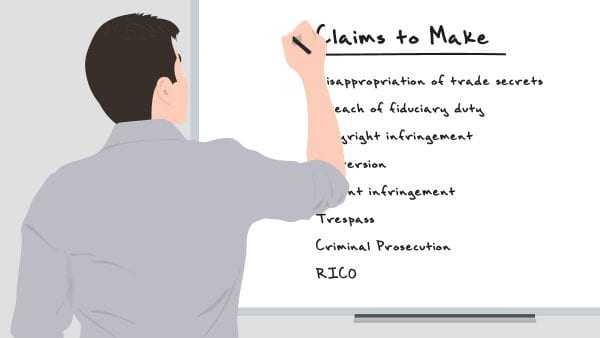
To put a halt to a disclosure, either through negotiation or litigation, your lawyer will need to show that you have solid grounds for a lawsuit against the person who violated the NDA. One legal claim you’ll make is that the person has committed the breach of contract. Also, you and your attorney must determine whether you have other grounds on which to sue the perpetrators
Each one you come up with may provide you with a separate remedy and separate damages. Here are some possibilities:
Misappropriation of trade secrets. When someone acquires or discloses your trade secrets by theft, bribery or fraud, you can sue under state trade secret laws for misappropriation. For more information, see Appendix A.
Breach of fiduciary duty. Courts recognize that certain business relationships-for example, the relationships of executive officers or members of the board of directors to the company-require a higher than normal degree of trust between the parties. These relationships are referred to as “fiduciary relationships,” and people or businesses in them are said to owe a duty of trust to each other. If that duty is breached, it may justify a separate legal claim.
Copyright infringement. Trade secrets often include written, visual or other materials that are protected under copyright law. If the person who violated the NDA published, or distributed the materials, you may be able to claim copyright infringement. See Trade Secret vs Copyright.
Conversion. Conversion occurs when someone, without authorization, deprives you of your use and possession of personal property (that’s anything but real estate). For example, conversion occurs if a former employee takes a company’s computer hard drive. It differs from theft, a crime that is prosecuted by government attorneys and may result in imprisonment.
Patent infringement. Someone who violated an NDA may also have infringed a patent. Patent infringement occurs when someone sells, manufactures or uses a patented invention without authorization.
Trespass. Trespass is the unauthorized entry on another person’s real estate, for example, if someone breaks into your office. This differs from criminal trespass, a crime that may result in imprisonment.
RICO. The Racketeer Influenced and Corrupt Organizations (RICO) Act allows someone to sue a person or business that engages in a pattern of criminal activity. For example, if a business steals your secrets and bribes your employees, you can sue the business for violation of RICO. Even though it involves criminal activity, a RICO claim is a civil claim and can result in an award of financial damages.
Criminal Prosecution. Several states and the federal government have passed laws that make the unauthorized disclosure, theft or use of a trade secret a crime. Under these laws, the government, not private businesses, arrest the perpetrators and brings criminal charges. The penalties-including imprisonment-can be much more severe than in a civil suit. A person convicted of violating the federal Electronic Espionage Act of 1996 can be imprisoned up to 10 years. The filing of a criminal case does not prevent you from suing. For example, in a case involving the Avery-Dennison company, a Taiwanese competitor was ordered to pay $5 million in fines to the government as a result of criminal charges and $60 million to Avery-Dennison as a result of a civil lawsuit involving claims of trade secret misappropriation, RICO violations, and conversion. Criminal prosecutions of trade secret theft are rare because many businesses prefer not to bring law enforcement officials into the fray. Also, in some cases, law enforcement officials don’t wish to prosecute because there may not be sufficient evidence to obtain a conviction. Keep in mind that the standards of proof for criminal cases are higher than for civil battles.
Step 4 – Attempt to Settle

How has the trade secrecy loss affected your business? You need to know in order to figure out what you want from the perpetrators.
For example, if you intended to patent an invention, disclosure of confidential information may ruin your chances.
Three (3) stages of trade secret misappropriation:
- Threatened
- Continuing
- Completed
The extent of your injury and the appropriate remedy depend upon which stage you’re at.
A threatened misappropriation is one in which your confidential information has not been disclosed to the public or used by a competitor. For example, if you learn that an ex-employee was photocopying your company’s trade secret material and will soon be starting work with a competitor. This type of problem is sometimes resolved by a written request to the employee to return all confidential materials. If that fails, you may need to quickly go to court for an order requiring the employee to return the materials and not disclose them.
In a continuing misappropriation, an injury has occurred, but trade secret rights may not have been lost. For example, a competitor is using a secret of yours but has not publicly disclosed it. In this situation, you may be able to obtain a court order halting the unauthorized use and, in some cases, to receive compensation from the competitor. In this way, your business can still retain trade secret rights.
A completed misappropriation is one in which your injuries are extensive and irreversible. You can’t reclaim trade secret rights because the secret has been publicly disclosed or extensively used by a competitor. In other words, a court order prohibiting continuing or future uses would not provide much benefit because the cat is out of the bag. The best remedy is to file a lawsuit and demand a financial payment from the competitor: either your lost profits or the competitor’s profits. Or you might allow the competitor to continue using the secret and negotiate a continuing royalty.
As you can see, the extent of your injury also affects the speed with which you must take action. A threatened misappropriation requires immediate action; you must rush to obtain a court order preventing disclosure. The same immediacy is not present if the misappropriation is completed and the damage is done.
Like with medical injuries, your course of action in a trade secret dispute is dictated by the available cures (or “remedies”). You need to figure out your remedies before your attorney sends a letter to the other party. These potential remedies can be used as leverage to end the dispute before a lawsuit is filed. Potential remedies include:
Step 5 – File an Injunction

An injunction is a court order directed at those who have stolen your secrets. Asking for an injunction is common since the primary goal of an NDA is to keep information secret.
Courts are authorized to issue emergency injunctions, called temporary restraining orders (TRO’s) in a matter of days when you show that a trade secret is at risk of being lost as a result of the misappropriation. The court must then schedule a hearing at which all sides may be heard. If, after this hearing, the court still believes that a trade secret is at stake and that you will probably win at trial, it can issue a “preliminary” injunction. This order will continue to prevent further use or disclosure of the trade secret pending a final decision in the case. As a practical matter, once a preliminary injunction is granted, the parties often settle, rather than fight the case through to trial and beyond.
Sometimes injunctions are permanent -that is, they are final court orders in the case. More commonly, courts give the rightful owner of the trade secret a “head start” by prohibiting the information’s use by the competitor for such period as the court decides it would have taken the competitor to independently develop the information.
If a court determines that an injunction would not be appropriate. For example, the competitor has already engaged in widespread use of your secret and has ruined your competitive advantage-the court can instead order your competitor to pay you a reasonable royalty for further use of the trade secret.
- Injunctions and Free Speech
The First Amendment to the U.S. Constitution prohibits the government from placing restrictions on a person’s freedom of speech. One exception to this rule is that a court may issue an injunction against the public disclosure-usually in the form of a publication of trade secrets that have been obtained in violation of an NDA, for example, if an employee violates an NDA and gives trade secrets to a reporter. A court would weigh several factors when deciding whether or not to forbid the reporter from publishing the secrets. The court would consider the commercial interest in the trade secrets, the reporter’s right to speak freely and the illegal behavior used to acquire the trade secrets.
Step 6 – Seek Damages and Legal Fees

If you suffer a financial loss as a result of a breach of an NDA, you may be able to get a court to award money damages to you. Your damages are measured by either:
the profits a competitor earned by using the trade secret, or
the profits you lost due to the improper trade secret leak.
If the person or company you’re suing acted with spite or ill will or a disregard for the probable injury (defined as “willful and malicious”), courts in many states can impose punitive damages. These are damages awarded to you for the purpose of punishing the wrongdoer and providing an example to other would-be trade secret thieves.
EXAMPLE: A court awarded punitive damages when an executive who took trade secrets from his former employer also intentionally deleted the information from company computers and removed all traces of the technology from the company offices. This conduct led to a finding that the theft was willful and malicious. Bond v. Polycycle, Inc., 732 A.2d 970 (1999).
In reality, courts often strike down any punitive damages that are too far out of sync with the actual damages. In most states that have adopted the UTSA, punitive damages are limited to twice the amount of actual proven damages. For example, if the compensatory damages were $10,000, the court could award only $20,000 in punitive damages (for a total award of $30,000).
- Attorney’s Fees
If your NDA includes an attorney fee provision, you can ask the court to direct the other party to pay your lawyer’s bills if you prevail. If you settle the case, neither side has to pay the other (unless the attorney fee payment was negotiated as part of the settlement). Even if there is no attorney fee provision in an NDA, a court may require the other side to pay your attorney fees if it is engaged in “willful and malicious” misappropriation. This decision is up to the judge.
What to do if You’re Accused?
If someone accuses you of violating an NDA, you should take a course of action similar to that described above. Review your NDA, retain an attorney, investigate the trade secret, determine the facts and review the defenses, remedies, and alternatives to litigation.
Also, check your company’s insurance coverage. Your comprehensive or commercial general liability insurance (CGL) policy may pay your attorney costs for defending the suit. Coverage is often established in a provision known as “advertising injury.” Some courts interpret this provision to require insurance companies to defend lawsuits in which the trade secrets relate to marketing information. Consult your attorney and notify your insurance company promptly.